
Magnificent Muriel Hind | Britain's First Woman Motorcyclist
Updated: Oct 3
An Edwarian Lady Motorcyclist who roared into the future for women like me

Nellie Seller finds me the first woman motorcyclist
Nellie’s sing-song Brummie tones dropped into my ears as I was scrolling through pictures of old BSA motorcycles. I was struggling to get my writing mojo back having been flattened by the drudgery of marketing on social media for endless dogged months. I paused at a picture of an Edwardian lady by a motorcycle and then I heard Nellie.
“Ooh! I’d love one of them.” I stopped scrolling.
“Why not?” I said to her. She’s spent all of Book 2, so far, helping her mother, Elizabeth and her sister-in-law, Alice Louisa, with the children. Then she was saddled with caring for her father, William, and a new business of teaching children to play the piano.
Where in all of this does Nellie do anything for herself?
She’d love to be part of the women’s suffrage movement but hasn’t the time. Besides, she’s the one looking after Alice’s children while she’s off demonstrating for the women’s vote at the Bingley Hall.
“Yes, Nellie,” I said. “You shall have a motorcycle. What’s more,” I added, “You can have a Watsonian sidecar outfit later on and take the children up to the Lickeys for a day out.”
You should have heard the whoop and laughter. Ah Nellie. She’s fast becoming my new favourite character. I can feel myself sparkling as I type, my writing mojo is back and I can’t wait to share these lovely chapters with you. They come just before the heaviness of the Great War and play an important part in the energy of the book. Just like the Botanical Gardens chapter in ‘Angelina’, it gives the reader a break from the harshness of industrial Birmingham.
Magnificent Muriel

My promise to Nellie took me searching specifically for Edwardian women motorcyclists and that’s where I found the magnificent Muriel Hind. Born in 1882, she was orphaned at seven, brought up by relatives and by twenty-one had her first motorcycle. By 1905 she was competing in trials and hill-climb events in both cars and motorcycles – just a twenty-minute care drive from where I live.
Her first motorcycles were made by the Rex Motor Manufacturing Company, in nearby Coventry, where she was one of the test riders. I know what you’re thinking. That’s mental! 1910 and a lady working as a test rider and beating the men in trials competitions? Bonkers!
In 1910 she contributed a regular column, ‘The Lady Motorcyclist’, in the weekly ‘Motorcycling’ magazine. It’s this magazine that Albert plops down on the kitchen table and Nellie picks up to read. Here’s the original passage written by Miss Hind that made Nellie decide she would buy herself a motorcycle.
“I like the feeling of power, life, the mighty rushing wind beating on one’s cheeks with the roar of the passing breeze and the beat of the exhaust deafening one’s ear. This is the power that drives and here is the motorcycle’s charm. But I am waxing too garrulous and must throttle down to legal limit or else the Editor will extend a warning hand and bid me stop.”
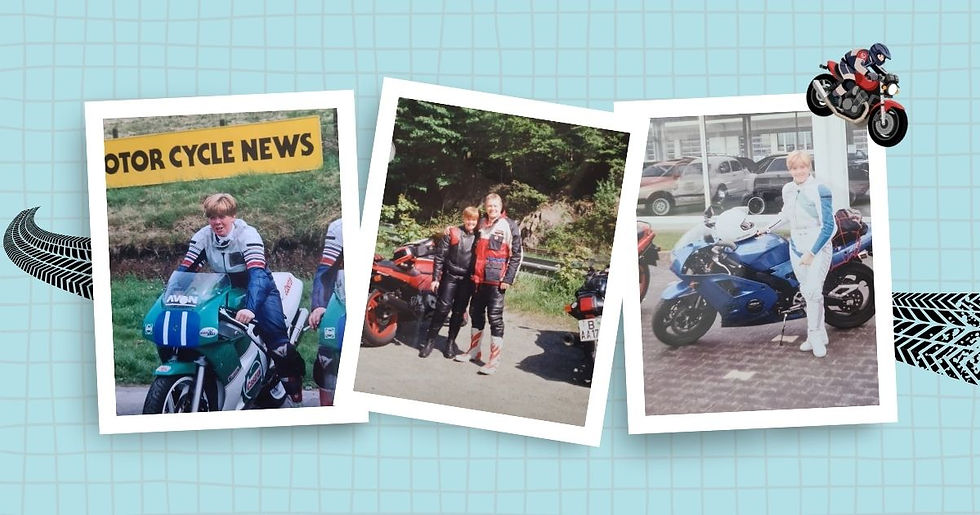
I totally identify with her words because I too was a woman motorcyclist. I got my bike license before marrying and my favourite bike was my husband’s Honda CBR600. We lived in Germany and used to ride from the north in Bergen Belsen down to the Harz mountains on a Sunday, just to find some corners to scream round. You cannot beat the smells and feelings that Muriel describes, not even on a horse.
Back to Muriel and Edwardian lady motorcyclists. The problem of dress was considered and Muriel succeeded in getting Rex to create a motorcycle frame allowing ladies to step through and sit on the bike. Split skirts were later designed — it was considered culturally unacceptable for ladies to wear trousers. During the days of the outspoken women’s suffrage movement this was an issue. Women were banned from various political meetings and so they gained entrance by dressing as men.
One of Muriel’s many achievements was driving a 9hp Singer tri-car from Land’s End to John O’Groats in 1906. These long drives and events meant that she was not only a driver but her own mechanic too. You'll see on the picture at the top that she has her spare chain on the handlebars. What a gal, eh?
Then came Marjorie Cottle and a raft of other women motorcyclists who took on dispatch riding during the Great War. That requires a whole other blog. I’ll leave you with a couple more articles on Muriel Hind. She and Nellie certainly put the sparkle back into my writing.


Research links for more on Muriel Hind
If you've enjoyed reading about the people who inspire my writing, you can subscribe to my newsletter which drops into your inbox fortnightly, or thereabouts, or, follow on Substack. I share insights on interesting folks from history who inspire my characters, also deep dives into my characters and the parts they play in my novels.


Comments